How Past Traumas Affect Our Decisions Today

Trauma does not only live in memory. It settles into the nervous system, teaching the body and mind what is safe, who to trust, and which roads to avoid. Years later, those lessons still steer us. You might hesitate to try something new, say yes when you mean no, or rush into a decision just to escape discomfort. None of this means you are broken. It means your system learned to survive. With language for what is happening and a few repeatable tools, you can choose with more clarity.

The Long Shadow of Early Experiences

Childhood is where many decision habits begin. If mistakes led to shame or cold distance, your brain learned that safety lives in perfection and predictability. If comfort was inconsistent, your body learned to scan for danger and prepare for loss. These lessons quietly shape adult choices. You double check every email, you rehearse every conversation, or you avoid opportunities that carry any uncertainty.

It helps to bring curiosity back to the picture, and many people do that by gathering neutral information before trying something new; in that spirit, a quick look at Liven reviews can satisfy simple curiosity about a tool rather than inviting anxious guesswork about what others are using or how you will measure up. When you replace assumptions with facts, your threat system relaxes and your planning brain can engage.

Early models also teach how to repair after errors. In supportive environments, a misstep is data that guides the next attempt. In critical ones, the same misstep becomes a verdict. If you grew up with verdicts, your first task is to gently separate “I did it wrong” from “I am wrong.” That single shift opens space for wiser decisions.

A Trauma, the Brain, and Decision-Making

Trauma can recalibrate systems for threat detection and control. When alarms are hypersensitive, ordinary choices feel high stakes. The mind imagines outcomes it cannot predict and the body reacts as if danger is certain. This can lead either to overanalysis and paralysis or to quick choices that promise fast relief.

Reward pathways can be affected too. When motivation feels flat, even good plans look pointless. That is not a moral failing. It is a brain expecting more pain than payoff. One way to nudge motivation is to make payoffs visible and near. Shrink goals, shorten feedback loops, and track small wins you can actually feel.

When anxiety involves other people, old fears of being replaced or ignored can flood the present. You start mind-reading, you see patterns that are not there, and you treat a small silence like a final judgment. A useful interrupt is to ask, “What do I know for sure and what am I guessing.” Then choose a grounded step, like clarifying a detail or asking for a check-in. It is amazing how quickly fear softens when facts return.

For some, gentle structure helps you notice patterns without judgment, and the phrasewhat is Liven’ often comes up in discussions about reflective prompts that keep check-ins simple. Whether you use paper or an app, the principle is identical. Awareness first, then a small, concrete action.

Patterns We Carry Into Adult Choices

Many trauma-shaped patterns are sensible in context, yet unhelpful now.

Overanalysis and avoidance. If error once brought punishment, you might chase certainty that does not exist. Decisions stall, opportunities pass, and the delay feels like safety.

People-pleasing. If belonging felt fragile, saying yes became a survival skill. As an adult, that habit can steer choices toward pleasing others rather than serving your values.

Impulse as escape. When discomfort feels intolerable, any move that ends it looks wise. You quit, you ghost, you buy, you move. Relief arrives, then regret.

Numbness and low reward. If your system learns to brace, joy can feel far away. Without a sense that effort will matter, decisions skew toward inaction.

Seeing yourself in one or more of these patterns is not a diagnosis. It is a map. Maps do not judge; they help you plan a better route.

Practical Steps to Regain Agency

You cannot think your way out of a threat response. Start with the body so the brain can reason.

Downshift physiology. Try one minute of breathing with a longer exhale. Inhale for four counts, exhale for six. Follow with a short grounding sequence: five things you see, four you can touch, three you hear, two you smell, one you can taste. A calmer body makes steadier choices.

Use tiny, timed decisions. Give a decision in ten minutes. Write options in plain language. Pick the smallest reversible step and take it. Schedule a review for tomorrow. This keeps caution, but stops the spiral.

Name the old rule and write a new one. Old rule: “Do not disappoint anyone.” New rule: “Say yes when it aligns with values, and no when it does not.” Practice the new rule in one low-stakes situation today.

Anchor in values, not moods. List three values you want more of this month. When stuck, ask which option serves one value. Values are stable. Fear is not.

Make rewards visible. Break goals into actions you can complete and feel. Track wins in a single line: “Asked for help,” “Sent the draft,” “Took a walk before deciding.” Pleasure teaches your brain that effort is worthwhile.

Create clean requests and quick repairs. Speak needs in short sentences: “I need a heads-up before plans change.” If you snap, repair quickly: “I was flooded and spoke sharply. I am back. Can we try that again.” Repairs restore safety fast, which keeps your decision system online.

Plan for low-battery days. Keep a written plan with one easy meal, one boundary message, one grounding exercise, and one task that moves life forward. When energy dips, the plan makes the first decision for you.

Conclusion

Past traumas trained your system to survive. That training still whispers during your choices. You will feel it when you hesitate, when you rush, when you agree out of fear, or when you go numb. None of this disqualifies you from a good life. Start small. Calm your body, name the old rule, write a kinder one, and take one reversible step that serves your values. Do it again tomorrow. Over time, decisions stop echoing the past and begin to reflect the person you are becoming.

How to Customize Tax Return Envelopes for Your Firm

One thing you shouldn’t have to worry about during the tax season is how you present your clients with their documents. A plain envelope works, but a custom one brings order and professionalism to the process. 

Custom tax return envelopes are more than just about looking good—they are a tool of uniformity and trust. They are an opportunity to communicate the name of your firm, give clear direction, and protect documents that no one should see. 

If you’ve ever had clients who lost important paperwork or if you want to hand out returns in a way that demonstrates your careful consideration, custom return envelopes can lend a professional edge. This is how to approach them one by one.

1. Start with the Right Type of Envelope

The first step is choosing the right style of tax return envelopes for your needs. There are a few options for formats, including double-window, single-window, and plain. Double-window designs allow you to show both your company’s address and the client’s, which simplifies your mailing. 

For basic use, single-window versions keep it simple while still looking professional. And plain envelopes are better when you’re in control of the design and the positioning of the text.

Consider what you’ll use most often. If you’re sending out larger packets, 9×12 envelopes are much better than smaller ones. If security is a concern, use an envelope with a tinted inside or use labels that will cover your client’s sensitive information fully. 

You may also want to consider expandable envelopes if your returns tend to be bulkier. Starting with a good base will ensure both form and function.

Image Source

2. Add Your Firm’s Information Clearly

After you’ve selected the type, the next step is ensuring that your firm’s information is printed on the envelope for easy readability. At a minimum, this is your company name, address, and phone number. Some companies even add their logo to create a branding opportunity.

The positioning of this information is important. For instance, a pre-printed return address in the upper left corner is a time-saver when sending multiple packets. It all looks cohesive when your colors and fonts are consistent with your other materials. 

You also have more options for where you would like your branding to be if you are using plain envelopes. Windowed envelopes need less customization, but you can still place a logo and tagline for professional polish.

Clients maintain tax records for years. By printing your information directly on the envelope, you make it easy for them to find you again without digging through old files.

3. Prioritize Privacy and Security

Taxpayers have the right to confidentiality, and tax forms are filled with sensitive information. That’s why your envelopes should indicate how seriously you regard that trust. Customization isn’t just about aesthetics—it’s about showing your clients you value their confidentiality.

Look for designer tax return envelopes with security tints that obscure text inside. Self-sealing closures are another important feature that reduces tampering risks. Larger flap styles also provide extra coverage while giving the envelope a neat finish.

If you’re delivering packets by hand, go for thicker envelopes that won’t wrinkle in transit. For mail, make sure your design doesn’t interfere with postal codes or barcodes. Balancing security with practicality ensures that returns are both safe and professional-looking.

Image Source

4. Design for Clarity and Function

Your design doesn’t have to be complicated. The objective is to keep the envelopes practical while reinforcing your firm’s identity. Simple details like adding your brand colors or a tagline below your logo make them instantly recognizable.

Think about usability, too. Envelopes with checkboxes or labeled sections, such as “Client Copy” or “File Copy,” help clients stay organized. You might also include bold instructions on the back flap, like reminders to store the documents securely.

Since your envelopes are often the first thing clients see before opening their returns, thoughtful design sends a strong message that you care about the little details.

5. Include Clear Mailing Instructions

One simple, but potentially valuable customization is to include mailing instructions right on the envelope. For those firms that have multiple clients at their offices at any given time, this can help reduce any confusion and improve delivery times. 

This can be as simple as having something printed like “Tax Documents Enclosed,” “Do Not Bend,” or even “Confidential.” These quick notes will let both the postal service and your clients know how you want the envelope handled.

Some companies put color-coded stickers or those with printed words to identify one type of document from the others. This is effective, especially if your office releases return envelopes for personal and business tax returns. Be upfront about it so your clients won’t have to guess.

6. Plan Ahead for Bulk Ordering

Customization works best when planned. Ordering in bulk not only saves costs but also ensures consistency throughout tax season. Using the same design for all returns keeps the process smooth and avoids running out at the worst time.

When finalizing your design, consider how it will look across different envelope sizes. You may need both standard mailing envelopes and larger 9×12 ones for complete return packets. Maintaining a consistent design across all ensures a unified brand presence.

Bulk orders also help you avoid delays. The last thing you want in peak season is scrambling for mismatched envelopes. With a steady supply ready, you’ll stay efficient and organized.

Image Source

Final Thoughts

Personalized tax return envelopes give your practice more than a polished look. They keep you organized, protect client privacy, and enhance professionalism. By starting with the right type, printing your details, and designing with security and clarity in mind, you set the stage for better client communication. 

In the end, these envelopes may seem small, but they make a lasting impression. They safeguard necessary paperwork, keep it easily identifiable, and demonstrate that you take the same pride in presentation as you do in preparing accurate returns.

7 Tips for Picking Comfortable and Stylish Maternity Dresses

Your body keeps changing, comfort matters more than ever, but you still want to look good and feel confident. Maternity dresses move with your growing bump, are easy to wear, and give you space. With the right picks, you can feel comfortable and ready for anything your pregnancy throws your way. To make things easier, here are seven tips that will help you choose the right maternity dresses.

1. Choose Stretchy, Comfortable Fabrics

Choose soft, stretchy materials like jersey or cotton blends that move with your body rather than digging into it. On hot days, breezy fabrics such as linen are ideal since they help you stay cool. Soft fabrics are also more pleasant because they don’t irritate your skin; instead, they make you feel more at ease. As your belly grows, fabrics that do not stretch may be more uncomfortable. 

2. Get Dresses with Adjustable Ties 

Remember, flexibility is key, especially for expectant mothers, as the body undergoes several changes. Dresses with adjustable ties, elastic waists, or wrap designs allow you to modify the fit of your attire as the months go on. Wrap dresses are not only flattering but also beneficial since you can continue wearing them after delivery, which ensures you won’t have to buy more dresses the following month.

3. Choose Support and Coverage That Feels Right 

Dressing yourself feels a bit different at the moment, and some days you may wonder what is going to work in your chest area. If the nearest thing to your ideal dress includes a little more cloth, pick dresses with thicker, broader straps or higher necklines. A few maternity dresses have integrated backing cups, which could also be better suited to make you feel comfortable without adapting periodically. making

4. Maintain a Comfort-Style Equilibrium 

Many dresses include patterns that, like pregnant people, cover the whole array, from bright flowers to modest, beautiful colours. Choose clothing that matches your tastes and makes you seem more comfortable while doing it. Maxis and midis, for instance, are beneficial since they provide excellent protection and can seem fancy or cosy depending on how you pair them with a jacket versus a heel. 

5. Consider Use 

Take note that a diverse closet does not simply imply that you can use the part with something unique. Many flexible clothes may be adapted with spiked high heels, with sneakers and pads. Dark colours are simple to blend and suit, while distinctive elements are enjoyable when you choose to look unique. Plus, a short garment that may be worn in several ways saves you money, effort, and energy.

6. Dress for the Season

For the summer months, choose light fabrics and sleeveless or short sleeves that keep you cool. While in the winter, going for a long-sleeved dress in a heavier material, like knitwear, is the best choice. Layering may help your maternity dresses last longer; then toss a cardigan on over a lighter dress. Seasonal comfort means you’re not left with pieces that only feel right for a matter of moments.

7. Dresses That You Can Wear After Pregnancy

Lots of maternity dresses are designed with nursing features such as wrap fronts, so you’ll keep wearing them long after the baby is born. These styles represent a better value and make the transition from pregnancy to motherhood more seamless, since you already have clothing that serves both purposes.

Buy Maternity Dresses with Confidence Today

Shopping has a huge selection of maternity dresses that cater to the first, second, and third trimesters. Shopping online also allows you to compare styles, fabrics, and prices without ever leaving home. Whether you’re looking for comfortable everyday solutions or want to get something a little dressier when you’re getting dolled up, we have finds that meet your needs and keep you and baby comfortable.

How to disable WebRTC and why you need to know this

For years now, the popular internet security site whoer.net has drawn attention to a critical privacy issue — IP leaks caused by WebRTC technology. WebRTC (Web Real-Time Communication) is a browser feature designed to enable real-time voice, video, and data sharing. However, this convenient functionality carries an unexpected risk: your real IP address can be exposed, even if you’re using a VPN or proxy.

Why WebRTC IP leaks are a serious concern

Many users believe that using a VPN or proxy is enough to fully hide their location and identity online. Unfortunately, WebRTC can bypass these protections by creating peer-to-peer connections that expose your real IP address. This undermines anonymity and can put sensitive activity at risk – especially when anti-fraud systems are involved.

Advanced tools like antidetect browsers can spoof browser fingerprints and mask other identifying data, but if you rely only on a VPN, then WebRTC becomes your responsibility. Without proper webrtc disable settings, you leave a vulnerability that can be easily exploited to deanonymize you.

How to disable WebRTC in your browser

Knowing how to disable WebRTC correctly in your browser is crucial to stop IP leaks and protect your online identity.

  • Firefox: The most straightforward method is to open a new tab and type about:config in the address bar. Then, search for the setting media.peerconnection.enabled and set it to false. This effectively disables WebRTC in Firefox and stops any WebRTC leaks. Many users prefer Firefox for this reason, as it provides direct control without needing extra extensions. You can also search for firefox disable webrtc to find detailed guides.
  • Chrome: Google Chrome does not have a built-in toggle for WebRTC. To disable WebRTC chrome users typically install a browser extension such as WebRTC Control, which allows you to easily block WebRTC leaks with a single click. This extension works well for Chrome and other Chromium-based browsers. On Chrome Android, unfortunately, extensions are not supported, so your options are limited. Some users switch to alternative browsers with better WebRTC protection or rely on VPN apps that include webrtc block features.
  • Other Chromium-based browsers: Most browsers like Edge or Brave share Chrome’s base and also require extensions like WebRTC Control to block WebRTC leaks.
  • iPhone (Safari and others): iOS browsers have limited options for disabling WebRTC. Safari does not allow disabling WebRTC directly. Switching to browsers like Firefox for iOS can help, but it’s also important to combine this with VPN usage. Searching for how to disable WebRTC on iPhone will often lead you to recommendations for privacy-focused browsers.

Practical steps to prevent WebRTC leaks

To maintain your privacy, consider these measures:

  1. Install a reputable WebRTC-blocking extension if your browser does not offer native controls.
  2. Regularly test your connection on sites such as whoer.net to verify that your real IP remains hidden.
  3. Combine disabling WebRTC with other privacy tools like VPNs and anti-tracking extensions for layered security.

WebRTC is a powerful technology that enhances online communication, but it also introduces serious privacy concerns that shouldn’t be ignored. The first step to protecting your anonymity is understanding how to disable WebRTC properly and effectively. As rightly pointed out by whoer.net, if WebRTC leaks aren’t controlled, your IP address can be exposed — even when using a VPN. It’s crucial to disable this feature in advance, especially if you deal with sensitive information online and want to ensure your identity and activity remain hidden from third parties.

Managing Remote Teams Without Losing Your Mind

Remote work sounded like paradise at first. No commute, flexible hours, working in sweatpants. And then reality hit: overlapping schedules, missed standups, constant “what time is it for you?” conversations.

Turns out, managing distributed teams isn’t about fancy tools—it’s about having the right scheduling system.

The Problem: Too Many Calendars, Too Little Time

When your developers are in Berlin, your designer’s in Toronto, and your client insists on weekly check-ins from Sydney… chaos is inevitable. Even the best managers get trapped in endless calendar juggling.

And let’s be honest, traditional tools don’t cut it anymore.

How Smarter Scheduling Fixes the Mess

This is where modern platforms like https://wellpin.io/ step in. Instead of forcing everyone into rigid slots, they adapt to how teams actually work.

  • Automatic time zone adjustments (no more mental math).
  • One-click meeting scheduling across the whole team.
  • Built-in focus time protection so nobody burns out.
  • Mobile access, because remote doesn’t mean tied to a desk.

It’s not just about setting meetings. It’s about creating order in the chaos of remote collaboration.

Why Leaders Should Care

Every hour lost to scheduling conflicts is an hour not spent shipping features, talking to clients, or improving the product. That’s why managers leading remote teams are adopting tools that do the heavy lifting for them.

With https://wellpin.io/, scheduling becomes invisible—leaving room for actual work.

Closing Thought

Remote work is here to stay. The question isn’t whether your team can adapt—it’s whether your tools can. And if your current system still feels like duct tape holding a mess together, maybe it’s time to switch.

Start with https://wellpin.io/ and see how much smoother your week can actually be.

What Types of Slots Does Betvisa Casino Offer?

Betvisa Online Casino boasts an impressive selection of slot machines tailored to players from Bangladesh and designed for betting and winnings in Bangladeshi taka (BDT).

The platform has brought together hundreds of different slots in one lobby, from classic three-reel slots to progressive jackpots and cinematic 3D slots. Thanks to such a wide range, every guest will find a format that suits them: some appreciate the dynamics of Megaways, others are looking for the simplicity of the classics, and for some, it is important to instantly move to the bonus game via the Bonus Buy option. Below are the main categories of slots available at https://bv.casino/, their features and advantages.

Classic Slots: The Power of Nostalgia and Fast Pace

Classic slot machines remain the hallmark of any online casino, and Betvisa is no exception. This section features three-reel and, less commonly, five-reel models inspired by real-life ‘one-armed bandits’. Fruit symbols, BARs and sevens instantly bring to mind land-based clubs, while the extremely simple rules attract newcomers.

Classic slots usually have one vertical row and several fixed paylines. This allows you to keep the game under control and plan your budget better. The absence of complex bonus games speeds up the sessions: one spin lasts only a few seconds, and the results are immediately displayed in Bangladeshi taka. Fans of measured, ‘clean’ gameplay also note the higher average RTP of these machines. In addition, the small number of symbols makes the probability of winning more transparent, which enhances the feeling of involvement.

Video Slots: Modern Entertainment with Rich Visuals

Video slots make up the largest part of the Betvisa catalogue. These machines are traditionally built on five reels with multiple paylines, but the software capabilities allow for the implementation of:

  • cascading respins
  • expanding wilds
  • interactive mini-games.

Signature graphics and well-developed storylines turn the usual spinning of the reels into a whole adventure. Step by step, the player unlocks additional levels, multipliers or free spins, while dynamic music enhances the emotional impact.

The advantages of this category include flexible betting and a fast pace. Moderate risk takers can choose slots with medium volatility and regular small payouts, while big prize hunters will find games with high variance and a potential maximum payout of tens of thousands of BDT per round. Video slots are supported by Windows, macOS, Android and iOS platforms, so you can spin the reels anywhere: at home, on the road or on holiday.

Jackpot Slots: A Chance for Instant Riches

A separate tab on Betvisa is dedicated to progressive and fixed jackpot slots. The main feature is the growing prize pool, which is formed by the contribution of all bets. When a lucky spin activates the jackpot combination, the amount is sent to the winner in full, and the counter is reset and starts growing again. This means that the funds can reach millions of Bangladeshi taka and literally change a player’s life in a day.

Betvisa jackpot slots are divided into several subtypes. Local slots accumulate bets only within a single game, while network slots can combine several titles from the same studio. Often, the jackpot draw is accompanied by special effects: the reels transform into a wheel of fortune, and the hero of the story opens a safe with gold. Despite their high volatility, these games are hugely popular thanks to their exaggerated tension and the chance to win a jackpot worth a million times the original bet or more.

Megaways: A Mathematical Revolution and Thousands of Lines

Megaways slots are based on an innovative mechanism where the number of symbols on the reels changes with each spin. The basic algorithm is capable of generating up to 117,649 ways to win, and in some releases, the number exceeds 250,000. This format guarantees unpredictability and exciting dynamics: each spin is unique and can lead to a chain of cascading wins with an increasing multiplier.

The scale effect is enhanced by additional features:

  • expanding reels
  • mystery symbols
  • unlimited respins.

Megaways games are valued primarily by experienced Betvisa guests who appreciate the high potential of multipliers and the ability to quickly increase their bankroll.

At the same time, the interface remains intuitive: a Spin button, a betting panel in BDT and a counter of active paths to victory. Visually, Megaways slots are on par with video slots, offering colourful graphics and themed animations.

3D Slots: Presence Effect and Cinematic Quality

Betvisa’s portfolio includes a separate range of 3D slots created on next-generation game engines. The main feature is the depth of the image and smooth camera transitions that blur the line between the game and a full-length cartoon. 

The reels are often integrated into the storyline: for example, they can be located on board a spaceship, and the symbols can come to life and interact with the scenery.

Three-dimensional slots are complemented by complex bonus rounds: the hero engages in battle with a boss, collects artefacts or opens chests. This setup turns the game into a short interactive film where the outcome depends on chance but feels like a personal achievement. The deeper immersion encourages players to stay longer and explore every game mechanic to the fullest.

Bonus Buy Slots: Instant Entry into the Bonus Game

For those who prefer not to wait for free spins to be activated naturally, Betvisa offers a selection of Bonus Buy slots. For a fixed fee, usually a multiple of the current bet, you can instantly launch the main bonus round. The user saves time and immediately finds themselves in the zone of maximum winning potential.

This feature is suitable for players who are not afraid of increased volatility and are willing to take risks for instant access to multipliers. At the same time, the Paytable always shows the theoretical RTP for both the regular game and the bonus purchase, allowing you to make an informed decision. The option is paid for from your current balance in BDT, so it’s easy to control your spending.

Conclusion

The variety of slot types at Bet Visa makes the platform a universal entry point for audiences of all experience levels and playing styles.

Classic slots offer nostalgic fun, video slots impress with their depth of storyline, jackpots beckon with their unpredictability, and Megaways and 3D technologies take gameplay to a new level of excitement. The ability to purchase bonuses directly from the start screen further expands the winning scenarios. A wide selection, regular new releases, and stable performance on all devices set Betvisa apart as a platform capable of satisfying the demands of both beginners and seasoned thrill seekers.

Why 1Win India is the Leader in Cricket Betting: Unique Markets and Opportunities

1Win India confidently holds the leading position among cricket betting platforms in the country, and there are good reasons for this. Since entering the Indian market, the bookmaker has quickly gained the trust of millions of players thanks to its focus on local characteristics and the favourite sport — cricket. This sport is not just a game in India, but a national passion, and 1 Win takes this passion into account as much as possible, offering unique opportunities and a wide range of bets that make it a favourite among bettors.

We will tell you in detail what exactly sets 1Win apart from its competitors in the cricket betting segment.

Unique Cricket Betting Markets at 1Win India

1Win India’s main advantage is the wealth and variety of cricket betting markets, which makes the game exciting and as personalised as possible. The platform covers almost all major and regional tournaments that are popular with Indian fans. 

These include the legendary Indian Premier League (IPL), international matches, and championships such as the Pakistan Super League, Big Bash League, Caribbean Premier League, as well as numerous tournaments from Bangladesh, South Africa and other countries.

In addition to classic match outcome bets, 1 Win offers a wide range of specialised markets. Players can bet not only on the winner, but also on the outcome of specific game events: who will make the first six, how many points a player will score, the outcome of a particular round, the number of runs, interim results and much more. This variety allows you to create personalised strategies.

Moreover, 1Win is actively developing localised offers. This includes exclusive lines and marketing campaigns specifically targeted at the Indian audience. 

1Win Features and Functions for the Cricket Segment

1Win India is constantly introducing modern technologies and features to make cricket betting as convenient, fast and profitable as possible for its users.

  • One of the key advantages is the convenience of mobile apps and an adaptive version of the website, which are designed specifically with the Indian market in mind. Users can easily place bets from any smartphone or tablet, which is especially important for active and mobile players.
  • The platform offers high odds and low margins on cricket, which has a positive impact on bettors’ potential profits. This is especially important for those who bet regularly and want to make the most of their money.
  • The real magic of cricket betting at 1Win is revealed in live mode.As events unfold on the field, the odds change in real time, reflecting every rise and fall of the team. Here, speed of reaction is important — players can place a bet a second before the decisive throw or after an unexpected turn in the game. Built-in video broadcasts allow you to follow the match without leaving the betting line, and the convenient interface allows you to place several predictions at the same time. 
  • Newcomers to 1 Win can start with a welcome bonus that increases their first deposit and gives them a reserve for active play. During major tournaments, such as the IPL, themed promotions are held with free bets and increased odds on key matches. For regular players, there are cashback programmes that allow you to get back some of your lost funds, and personal offers for those who place large bets.

Easy Deposits and Withdrawals for Indian Users

1Win India provides the most convenient and secure financial transactions. The platform supports a wide range of local payment systems. Available methods include UPI, Visa and MasterCard bank cards, popular e-wallets and even cryptocurrencies.

Instant deposits allow players to quickly replenish their accounts without unnecessary delays and commissions, which is especially important for live betting. The withdrawal system is also designed for efficiency — users can count on fast transfers to their accounts without long delays.

Local Support Service and Work with Players from India

1Win India attaches great importance to quality user support and building strong relationships with players. The support service operates around the clock, offering assistance in several languages, including Hindi and English. 

In addition to standard chat and email, the platform offers personalised VIP services for regular and high-rollers, providing an individual approach and additional privileges. 1Win is also actively developing loyalty programmes, rewarding regular users with bonuses, cashbacks and exclusive offers.

Why 1Win India is Ahead of Its Competitors

In the world of cricket betting, competition is fierce, but 1Win India manages to maintain its leadership not only through its wide range of bets and generous bonuses.

Its key advantage is a combination of speed, flexibility and a focus on the real needs of players. Here, odds are updated instantly, markets cover both popular outcomes and niche events, and live betting is integrated with broadcasts so that you can react to what is happening without delay.

Compared to most of its competitors, 1Win offers a depth of betting options that is rarely found on the Indian market: bets on individual overs, on the statistics of specific players, and on unique match scenarios.

Plus, the site actively uses analytics and algorithms to tailor offers to current tournament events, putting it ahead of less flexible operators. It is also important that 1Win does not simply copy the approaches of international bookmakers, but adapts its service to Indian players.

From support for rupees and local payment methods to IPL-themed promotions, it all creates the feeling that the bookmaker ‘speaks the same language’ as its audience. As a result, players get more than just a place to bet; they get an ecosystem where every element, from the interface to the betting line, is tailored to their love of cricket.

Conclusion

1Win India deserves its leading position in the cricket betting market thanks to its wide and unique selection of markets, advanced technological solutions and user-focused service.

The convenience of mobile apps, competitive odds, a variety of financial instruments and attention to local characteristics make the platform the ideal choice for cricket fans in India.

For those who value innovation and reliability, 1 Win India is the optimal space for cricket betting. Discover the platform’s wide range of possibilities and start betting with confidence and comfort.

Tower X — Lucrative Gaming Opportunities from Smartsoft Gaming

The new Tower X Game was released in the summer of 2023. It was developed by Smartsoft Gaming. The guys already have experience with similar games, but here they decided to go a little further. The result is something unusual. The format is similar to a crash game, but instead of an airplane or rocket, we see a tower being built. Each round is a new skyscraper that grows right before your eyes. Now we’ll tell you why the game is so addictive and whether it’s possible to win real money here.

What’s the Point?

The player places a bet and starts the round. Then the system builds a tower out of blocks. Each new block is a new multiplier. The taller the building, the greater the chance of a big win. But, as in any crash game, there is always a risk that it will end before you manage to collect what you want.

And here’s the key difference from Jet X or Crash X. In Tower X, there is no “withdraw” button. More precisely, the cashout happens automatically. The player does not decide when to stop. The tower is completed first, and only then is the result fixed. This removes the main stress of crash games: you don’t have to sit with your finger on the button and guess when to press it.

Now about the blocks themselves. This is where it gets interesting. Each type of block has its own range of multipliers:

  • Suburb house gives modest coefficients — from ×1 to ×5.
  • City house is more substantial: ×6 – ×10.
  • Green house raises the stakes: ×15 – ×40.
  • Elite house gives more serious multipliers — from ×50 to ×90.
  • Neon house is the top of the line. Here, the coefficients can jump up to ×1000.

If the tower grows high enough and elite or neon blocks appear in it, the chances of a huge win become real. The maximum you can catch is up to ×5000 of your bet.

How Much Can You Bet

Bets in Tower X Game start at €0.01 and go up to €5. But there is a catch. Participation in a round costs ×100 of the selected bet. That is, if you choose €0.10, the real entry price will be €10. Because of this, the game is considered expensive for beginners. You can practise at the minimum level, but the real fun starts when you bet more.

Everything is modern here. There is a multiplier history. You can see what odds have come up before. There are betting tables. You can see who bet how much and what results they got. For competitive spirit, there is a leaderboard. Plus, there is a chat. You can discuss the results right during the game. The atmosphere is reminiscent of a real casino, only in an online format.

Tower X works on both computers and mobile devices. An APK file is available for Android, which can be installed directly. There is no separate app for iOS, but everything works fine through a browser. The optimisation is good. Even on less powerful phones, the game runs smoothly.

Which is Better: Tower X or Similar Games

The game has a fairly wide geographical reach. Tower X is currently available in 31 countries. To give a specific example, in Norway it is offered by 63 out of 421 online casinos. The numbers are also growing in other countries. New platforms are connecting to it every week.

Now about similar projects. Many compare Tower X to Jet X. This is logical: Jet X was a hit for Smartsoft. But here the approach is different. If Jet X is about an airplane that takes off at an unknown time, then Tower X is about construction, step by step. Visually, it is closer to the old game Tower Bloxx, where you also built buildings. The result is a mixture of crash mechanics and tower visuals.

It is also compared to other games in the genre. For example, Towers by Turbo Games. It also has the idea of levels. But Tower X still looks brighter and more atmospheric. Crash X is closer to the classic, with manual cash-out.

What are the Advantages of Tower X?

First, it has unique mechanics. The tower looks cool, and the process itself is different from the usual crash games. Second, auto cash-out. There’s no risk of you getting distracted and not pressing the button in time. The game decides everything. Thirdly, the odds. The chance to win ×5000 is a serious motivator.

And, of course, fairness. Everything works on RNG. The algorithm is random, so it’s impossible to predict the outcome.

But there are also disadvantages.

  • Volatility is high. This means that wins are rare, but when they do come, they are large. This may seem too risky for beginners.
  • The entry fee for a round is expensive. ×100 of your bet is a lot. Even if you choose the minimum bet, the amount still seems significant.

Tower X is clearly not for those who like measured gameplay. This game is for people who value excitement and the thrill of risk. Each new block makes you wonder what the next one will be. The tower grows, the odds increase, and so does the tension.

For experienced players, this is a new way to have fun. For beginners, it’s also an option, but it’s better to start with small bets to get a feel for the mechanics and not go into the red after a couple of rounds.

All in all, Tower X is an innovative crash game. It combines the dynamics of Jet X with the atmosphere of Tower Bloxx. The result is an unusual mix. If you like new experiences and are willing to take risks, then Game Tower X is worth a try. The main thing is to choose a reliable platform and control your budget!

How a DUI Conviction Can Affect Your Career and Future

One surprising fact: in Texas a first DWI can cost up to $2,000, a year without a license, and months in jail — consequences that ripple for years beyond the courtroom.

The guide shows how a single drunk-driving incident can change hiring decisions, licensing, and insurance rates. Employers often view a record as a risk, and insurers raise premiums quickly.

Texas law treats alcohol impairment seriously. For drivers under 21 the state follows a zero-tolerance rule, and administrative license actions start immediately with a 15-day window to request a hearing.

This section previews why penalties vary by state, how repeat offenses escalate fines and jail time, and why timing matters for program completion and credential renewals.

Readers will learn practical next steps: how to communicate with HR, manage background checks, and plan safe transportation while a license issue is resolved.

Understanding a DUI vs. DWI: Legal Definitions and BAC Limits

How a state defines impairment and sets a blood-alcohol ceiling shapes the penalties a driver may face. In Texas, for example, a driver is subject to a DWI charge at a 0.08% blood alcohol level or when alcohol or drugs clearly affect their ability to operate safely.

Terminology can differ: some jurisdictions call it DWI, others use different labels for the same conduct. Many states treat a first offense as a misdemeanor, while a few classify it as a civil infraction or impose mandatory jail time even on first offenders.

For drivers under 21, a strict zero-tolerance rule often applies. Limits for underage drivers commonly range from 0.00% to 0.02% BAC, and administrative license actions can begin immediately.

Authorities build cases using breath, blood, and field observations. When chemical results are unavailable or refused, documented signs of intoxication and officer notes may suffice to support charges and early license suspension.

  • Per se laws set numeric BAC limits.
  • Observable impairment can substitute for test results.
  • Even first-time offenses can harm employment, insurance, and schooling.

Immediate Consequences After Arrest and Conviction

Within hours of an arrest, a driver may face both courtroom penalties and separate administrative actions that run alongside each other.

Criminal penalties: fines, jail time, and probation

Court outcomes vary by state and past offenses. In Texas a first dwi can carry fines up to $2,000 and 3–180 days in jail.

Repeat cases bring stiffer penalties, longer jail terms, and higher fines. Judges often add probation and a required sentence that sets strict deadlines.

Administrative actions: license confiscation and suspension

Administrative License Revocation (ALR) moves quickly. A temporary license may be taken at arrest, and a formal suspension can start unless the driver files for a hearing within 15 days.

Administrative steps are separate from the criminal case and can limit mobility long before any court ruling.

Mandatory education, treatment programs, and community service

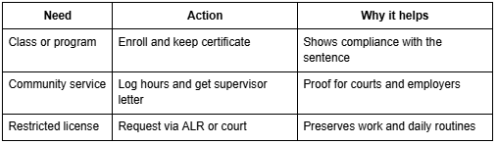
Courts commonly order alcohol education or treatment, plus community service hours and supervision. These programs carry costs and fixed timelines.

Missing required classes or a check-in for intoxication monitoring can trigger extended supervision or new penalties. Early planning—arranging rides and documenting progress—helps when meeting sentence terms.

  • Quick facts: administrative and court tracks run at the same time.
  • Expect added costs for classes, supervision, and lost driving time.
  • Compliance with education and community programs reduces the risk of harsher outcomes.

A skilled DUI lawyer Colorado like Shazam Kianpour understands the state’s strict laws and can build a strong defense.

License Suspension, ALR Hearings, and Restricted Driving Options

A short administrative timeline often decides whether someone keeps limited driving access or faces an automatic loss of privileges. After an arrest, administrative procedures run separately from the criminal case and can move quickly.

Administrative License Revocation starts a critical window. In Texas, a driver has 15 days to request an ALR hearing. If that request is missed, an automatic license suspension may take effect.

Hearing timelines and practical steps

Request the hearing right away and gather evidence: proof of employment, schedules, and witness notes. Scheduling the hearing early gives time to present why a restricted license is needed.

Occupational licenses and ignition interlock rules

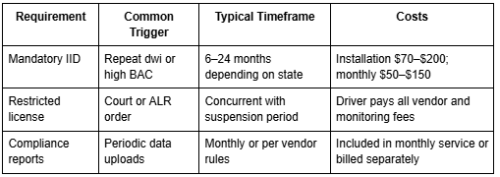
Courts often grant occupational or restricted licenses so a driver can get to work, school, or medical care. Judges may require an ignition interlock or IID as a condition.

  • First-offense suspensions commonly begin near 90 days in many states.
  • Installing an interlock device is usually at the driver’s expense and must be maintained per vendor instructions.
  • Missing required days of monitoring, driving outside permitted hours, or failing paperwork can add penalties.

Check insurance and employer policy early if driving is part of the job. Strict compliance with device rules and hearing deadlines reduces the risk of longer suspension or extra penalties under dwi laws.

Penalties by Offense Level: First Offense to Felony DUI

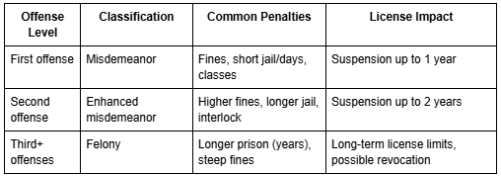
Each repeated offense brings tougher fines, longer suspensions, and higher risk of felony charges. The law treats a first offense very differently than later cases, so understanding the tiers helps a driver plan next steps.

First offense: typical outcomes

First offense often remains a misdemeanor in many states. Typical penalties include short jail time, fines, and a set license suspension tied to measured BAC or proof of impairment.

Second offense: stronger penalties

A second offense brings enhanced penalties, longer license suspension, and closer supervision. Courts may require an ignition interlock device and longer monitoring after repeat dwi matters.

Third or subsequent: felony exposure

By the third incident, many jurisdictions move to felony charges. Prison ranges can extend for years, fines rise substantially, and long-term barriers to employment and licensing follow.

  • Example (Texas): first—up to $2,000 and 3–180 days jail; second—up to $4,000 and 30 days–1 year jail; third—up to $10,000 and 2–10 years prison.

Enhanced Penalties and Aggravating Factors You May Face

Certain facts—like a very high blood alcohol level or a child in the car—can sharply raise the stakes in a traffic-related criminal case. States add enhanced penalties for clear aggravators to deter risky conduct and protect the public.

High BAC, test refusal, and open container rules

Many states treat a BAC at or above 0.15% as an aggravator. That can mean longer license suspension, mandatory ignition interlock, and steeper fines.

Refusing a chemical test often triggers automatic administrative action. An open container inside a vehicle may add separate policy violations even without observed impairment.

Accidents, injury or death, and child passenger consequences

Crashes that cause injury or death often upgrade charges to felony counts. In Texas, intoxication assault or manslaughter can bring prison time and long-term limits on driving.

Transporting a child under 15 can lead to child endangerment charges, extra jail exposure, and added license loss. These aggravators change how prosecutors view plea options and sentencing.

  • Quick take: high blood readings, test refusals, crashes, and child passengers commonly add penalties and complicate defenses.
  • Early mitigation—documented treatment, safe-transport plans, and prompt legal advice—helps when facing enhanced penalties and tighter supervision.

Ignition Interlock Device (IID): What It Is, When It’s Required, and Costs

An ignition interlock acts like a checkpoint on your dashboard — the car won’t start without a clean breath sample. It requires the driver to blow into an approved unit before ignition and may demand rolling retests while driving. Devices log results and send reports to courts or agencies.

How the device works and state rules

How it works: the unit measures alcohol on breath and prevents ignition above a set limit. Many states require an ignition interlock after repeat dwi matters, high BAC readings, or as a condition for a restricted license.

Installation, monitoring, and common mistakes

Drivers usually pay installation, monthly service, calibration, and removal fees. Missed service visits or ignored lockouts often extend required days of use.

  • Schedule calibrations on time and keep receipts.
  • Avoid alcohol-containing products that cause false positives.
  • Report malfunctions promptly to the vendor and court.

DUI Conviction Collateral Consequences: Career, Insurance, and More

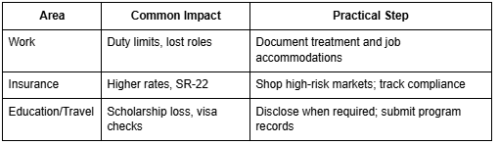
A recorded alcohol-related offense can ripple into work, insurance, and travel long after court orders end. Consequences often last for years and may affect hiring, licensing, and financial stability.

Employment and professional licenses

Background checks commonly reveal recent charges and convictions. Employers may restrict driving duties or deny roles that require a clean record.

Professional boards may ask for disclosure and proof of program completion when reviewing license renewals.

Auto insurance and SR-22

Insurers reclassify risk after a dwi. That can lead to higher premiums, loss of discounts, or policy cancellation.

Some drivers must file an SR-22 or buy high-risk coverage for specific days or years to regain standard rates.

Education, housing, and travel

Colleges and landlords may consider recent legal issues in decisions about scholarships, campus standing, or applications.

International travel and visa screening can be affected when an applicant has alcohol-related penalties on record.

  • Tell HR early and provide proof of completed programs.
  • Compare specialty insurers and ask about SR-22 timelines.
  • Plan time for classes and community service to keep work attendance steady.

Under 21 and Zero Tolerance: Special Rules for Young Drivers

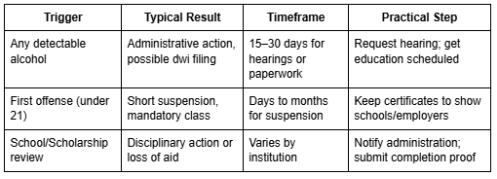
Young drivers face stricter rules: even a trace of alcohol can trigger formal actions and paperwork. Texas enforces zero tolerance, and most states set under-21 blood alcohol thresholds at 0.00%–0.02%.

Any measurable BAC can start an administrative license process. That often leads to a prompt hearing deadline and possible license suspension while matters move forward.

Lower limits, education, and quick suspensions

First offenses for drivers under 21 frequently carry mandatory education, short suspensions, and strict timelines measured in days. Schools may add conduct reviews that affect scholarships and campus status.

  • Arrange safe rides and document attendance for required education.
  • Meet hearing deadlines and keep proof of program completion.
  • Families should gather records to show compliance for employers or schools.

How to Move Forward After a DUI Conviction

A focused timeline makes it easier to meet program rules and protect job access while the case resolves. Start by listing court dates, class schedules, and any required service hours. Many states allow restricted driving with an ignition interlock during a suspension, so check local laws quickly.

Complying with sentences: timelines, community service, and program completion

Build a calendar that notes time windows and specific days for classes, evaluations, and community service. Prioritize employer-critical hours and arrange rides when the driver cannot legally drive.

Keep copies of receipts, enrollment confirmations, and IID installation records. Meeting each sentence term on time reduces the risk of added penalties and helps when requesting occupational licenses or ALR hearings.

Documenting progress: mitigating future consequences and rebuilding trust

Track attendance, collect completion certificates, and get supervisor letters for service work. Maintain a short case journal with dates, contacts, and proof of completion to show consistent responsibility.

Use education and counseling to show growth; this evidence may face scrutiny in later cases but often helps with job interviews and licensing reviews. Reconnect with local community supports to rebuild credibility.

  • Quick checklist: calendar, receipts, certificates, IID logs, and supervisor notes.
  • Communicate early with probation and HR; transparency and documentation matter.

Conclusion

A dwi can bring immediate steps and long-tail consequences. Beyond fines and jail time, drivers face license suspension, higher insurance, and work impacts that may last for years.

State laws differ, so careful attention to field sobriety results, chemical testing, and deadlines matters. Acting fast—requesting hearings, arranging safe transport, and starting required classes—can limit disruption.

While prison is usually reserved for serious or repeat cases, even a first offense creates steep costs and time demands. Document payments, certificates, and IID records to help with future licensing, job checks, and school reviews.

Takeaway: prioritize safety, use alternative transport, and lean on support systems to protect work, family, and the future.

FAQ

How can a driving while intoxicated finding affect a person’s career and future?

A court finding for driving while intoxicated can harm job prospects, especially in roles that require driving or a professional license. Employers often run background checks and may deny positions in transportation, healthcare, education, or finance. Licensing boards can impose restrictions or revocations, and some security clearances or federal jobs become harder to obtain. Rebuilding trust takes time, consistent compliance with court orders, and documentation of rehabilitation or treatment.

What is the difference between driving under the influence and driving while intoxicated, and what are typical blood alcohol limits?

Terminology varies by state: some use “driving under the influence” while others use “driving while intoxicated,” but both refer to impaired driving. Common blood alcohol concentration (BAC) limits are 0.08% for drivers 21 and older and 0.04% to 0.05% for commercial drivers. Drivers under 21 usually face zero-tolerance limits, often 0.01% to 0.02% BAC. State statutes define exact thresholds and related penalties.

What immediate criminal penalties might someone face after an arrest for impaired driving?

Criminal penalties can include fines, probation, mandatory alcohol education, community service, and jail or prison time for severe or repeat offenses. Sentences depend on prior records, BAC level, whether an accident occurred, and local laws. Courts may also require substance abuse assessments and enrollment in treatment programs.

What administrative actions can follow an impaired driving arrest, and how do they affect driving privileges?

Administrative actions often include license seizure, suspension, or administrative license revocation (ALR). States may impose immediate short-term holds and schedule hearings where the driver can challenge suspension. These measures act separately from criminal cases and can restrict driving long before court resolution.

Are education, treatment programs, or community service commonly required after a case for impaired driving?

Yes. Courts frequently order alcohol education classes, substance abuse treatment, ignition interlock installation, and community service. Completion often conditions reinstatement of driving privileges and can reduce other penalties. Program lengths vary by offense level and state rules.

What is the timeline for Administrative License Revocation and the importance of the 15-day window?

Many states require drivers to request an ALR or implied-consent hearing within a short window—commonly 7 to 15 days—after license seizure to challenge suspension. Missing that deadline usually means automatic suspension. It’s critical to act quickly and consult local rules or an attorney to preserve hearing rights.

What are occupational or restricted licenses, and when is an ignition interlock device required?

Occupational or restricted licenses permit driving for work, school, or essential duties during suspension periods. Courts or motor vehicle agencies often require installation of an ignition interlock device (IID) as a condition. IIDs prevent a vehicle from starting if the driver’s breath alcohol exceeds a set limit and are common for reinstatement after offenses.

How do penalties escalate from a first offense to a felony level?

A first offense typically yields misdemeanor penalties: fines, short jail terms, driver’s license suspension, and program requirements. A second offense brings heavier fines, longer suspensions, mandatory interlock devices, and increased jail exposure. Third or subsequent offenses, or cases involving serious injury or very high BACs, can elevate the charge to a felony with prison time, longer license loss, and long-term repercussions.

What aggravating factors lead to enhanced penalties?

Enhanced penalties apply for very high BAC readings, refusal of chemical tests, driving with a suspended license, having a minor in the vehicle, or causing injury or death. These factors increase fines, jail or prison exposure, and chances of felony charges. Courts and prosecutors treat such circumstances more severely.

How does an ignition interlock device work and what are common state requirements?

An IID requires the driver to provide a breath sample before the engine starts. If the test shows alcohol above the set threshold, the vehicle won’t start. Devices also require periodic rolling retests while driving. States differ on mandatory IID periods, installation providers, and payment of costs, which may include installation, monthly calibration, and removal fees.

What are typical compliance mistakes with interlock devices?

Common mistakes include missed calibration appointments, attempting to have another person blow into the device, failing rolling tests, and ignoring service notifications. Violations can extend the required IID period, trigger reinstatement delays, or lead to additional penalties.

How does a finding for impaired driving affect auto insurance and SR-22 requirements?

Insurance companies often treat offenders as high-risk, raising premiums substantially or canceling coverage. Many states require SR-22 or FR-44 filings to prove financial responsibility before regaining driving rights. These filings increase costs and remain on records for several years.

Can an impaired driving record affect employment, education, housing, or travel?

Yes. Employers may deny jobs or revoke offers after background checks, and professional licensing boards can discipline or refuse licenses. Colleges and scholarship programs may consider conduct violations. Some countries restrict entry for those with certain offenses, affecting travel and immigration prospects.

What special rules apply to drivers under 21 and zero-tolerance policies?

Under-21 drivers typically face much lower BAC limits and stricter penalties. States use zero-tolerance laws that can trigger immediate suspension, mandatory education, and longer monitoring. Even small alcohol amounts can lead to license loss and long-term record impacts for young drivers.

After a finding for impaired driving, what steps should a person take to move forward?

They should comply fully with court orders, complete all required education and treatment, install an IID when ordered, and keep clear records of compliance. Seeking legal advice, maintaining steady employment, and documenting rehabilitation efforts help mitigate future consequences and support opportunities for license reinstatement and record relief where available.

PDF Redaction Made Easy: What Every Internet User Should Know

Suppose you post a tax document online with a black marker covering up your Social Security number and think you have made yourself safe. You may raise an eyebrow at the fact that, with a couple of clicks, the rest of the world would still know what is being hidden. This is due to the fact that a major percentage of people fail to differentiate text coverage and text removal. 

In the digital world, redaction is not a black rectangle in the problem data; it is the disappearance of the sensitive information. Be it a salesperson sending invoices or a teacher making student reports, knowing how to properly mark out redaction data will prevent irritating data spills that can lead to legal and financial damage.

The Hazard of False Security

The problem? Most of the more popular redaction techniques provide their users with a false sense of security. Placing a solid black coloured shape over text in a PDF editor does not provide protection against highlighting, copying, or extraction of that data through basic PDF readers and even text editors. Indeed, researchers at the University of Illinois recently showed that redacted texts are totally retrievable based on the most hidden digital footprints. Their way of finding the information is known as Edact-Ray, and it managed to find the hidden data in the so-called ‘redacted files.’ In other words, if the information is not removed within the code of the file, it stays susceptible to discovery.

What to Do to Redact Properly

Redaction is not obscuring; true redaction means removing. The most effective methods don’t merely obscure the text, but erase it entirely from the file, including concealed metadata that may show the name, time stamp, and/or revision history. Significant characteristics of a quality redaction tool are:

  • Marked content is deleted permanently
  • Metadata scrubbing
  • The flattening of the layer or exporting of a clean file
  • Searchable redaction (to locate all the terms that should be censored)
  • A review section to check what has been deleted

For those who need a reliable and secure solution, PDFized offers an automated, online PDF redaction tool designed to meet modern compliance and security needs. The best tools are usually customized for HELO secure document handling. The following is a review of the best available today.

Tools You Can Trust

  • Adobe Pro. Perhaps the gold standard in PDF redaction, Adobe offers a tool that will allow you to search sensitive words, apply redaction marks, clean out metadata and save under a new name. It is high-quality and high end, which explains the premium pricing.
  1. Xodo. Being a sleek and secure web tool, Xodo enables redactions through your browser. It is locally run; no information will move out of your device. The censored material is permanently deleted, and the interface is also easy even for an amateur.
  2. Smallpdf. Perfect in case of one-time use, Smallpdf has a drag-and-drop free redaction feature. You edit the text and then add the blackout and download a revised copy that has content removed. 
  3. PDF-XChange Editor. The lightweight tool is Windows-based, and it provides redaction as well as OCR and metadata cleaning. It suits people who desire control and do not want to pay a monthly fee.

Remember Hidden Metadata and Document Properties

Your redaction of visible content may not be enough because you may still be revealing personal information in the metadata. This covers details such as the author of a document, its modification times, location data in photos, or previous folder versions within a PDF.

The most appropriate redaction tools provide a ‘sanitize’ or ‘remove’ metadata option. This should always be used after redacting and doing a final check on document properties before sending files.

The Daily Handbook to PDF Redacting

  • Step 1: Back up the original. You need to make a copy of the original document before you proceed to redact. That way, in case something malfunctions, you will still be able to get raw information.
  • Step 2: Use a specific redaction software. Utilize a secure application such as Adobe Acrobat Pro, Xodo, or Smallpdf to access the document. Indicate all the text or areas that require redaction. Try to make use of the search functionality to locate sensitive information such as phone numbers, emails, or names.
  • Step 3: Redact and sanitize. When you have selected all, apply the redactions. Go to the menu options and look for the option where you can find options like “Remove Hidden Information” or “Sanitize Document”.
  • Step 4: Export and check. Save the redacted copy (with a new name). Use it in other PDF viewers and see whether it preserves any data by trying to search it or copy it in redacted areas.
  • Step 5: Remove interim files. When you are certain you have enough copies, you can go ahead and delete the partial and temporary copies lest they accidentally leak.

In Real Life: What Could Go Wrong

Some well-publicized redaction mistakes are instructive:

  • In 2019, a large law firm carelessly exposed the identity of the client through the use of black highlights on the court papers as an alternative to proper erasure.
  • There was an online budget PDF published by a local municipality in which salaries had been ‘redacted’ (but a copy-paste could be performed).
  • Even reporters have become victims-uploading documents with names that are obscured, but can be searched.

These examples indicate why one should not just cover the text and leave it at that. When you plan to publish documents to the general population, redaction is your obligation.

Redaction Should Now Be Considerably Easier!

Redaction might seem a specialized topic, but it is rapidly becoming common and easier to understand. Whether you want to email a personal document, share something with your local group, or package files to send to the boss, smart redaction may be the difference between shielding yourself and others against harm.

With your data potentially being sold off, stolen, or otherwise mishandled with a single error, learning how to redact a PDF in a safe and secure manner is a skill that can take you to the next level of ensuring your digital security. Don’t make a black box your only line of defence. It is important to ensure that once information is out of sight, it is also out of mind.